
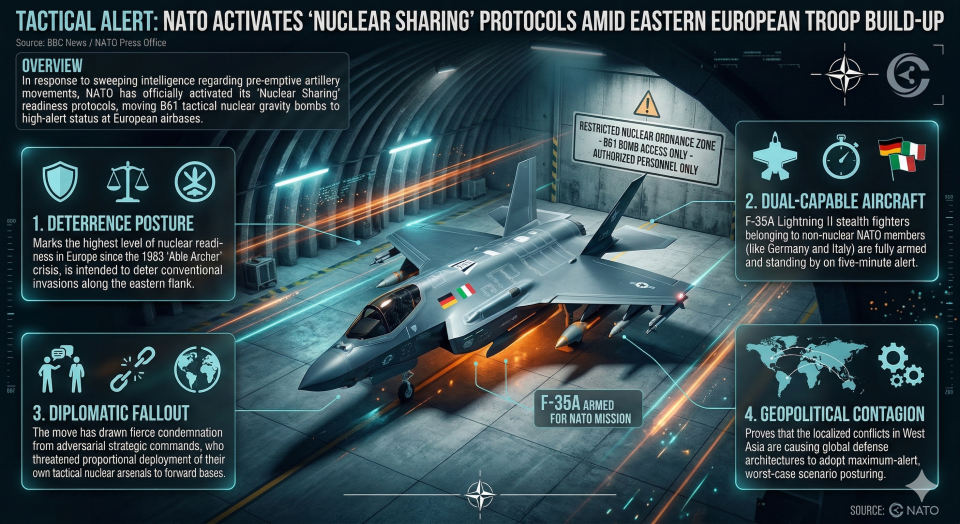
- Overview: In response to sweeping intelligence regarding pre-emptive artillery movements, NATO has officially activated its ‘Nuclear Sharing’ readiness protocols, moving B61 tactical nuclear gravity bombs to high-alert status at European airbases.
- Key Points:
- Deterrence Posture: This marks the highest level of nuclear readiness in Europe since the 1983 ‘Able Archer’ crisis, intended to deter conventional invasions along the eastern flank.
- Dual-Capable Aircraft: F-35A Lightning II stealth fighters belonging to non-nuclear NATO members (like Germany and Italy) are fully armed and standing by on five-minute alert.
- Diplomatic Fallout: The move has drawn fierce condemnation from adversarial strategic commands, who have threatened proportional deployment of their own tactical nuclear arsenals to forward bases.
- Geopolitical Contagion: Proves that the localized conflicts in West Asia are causing global defense architectures to adopt maximum-alert, worst-case scenario posturing.
Source Link: NATO Allied Command Operations
- Q5. In the context of the NATO alliance, what does the concept of “Nuclear Sharing” entail?
- A) The complete dismantling of all European nuclear weapons under a shared UN mandate.
- B) A policy where non-nuclear NATO members host nuclear weapons of a nuclear-armed member (like the US) and train to deliver them in times of war.
- C) The sharing of nuclear power plant technology for civilian energy production among allied states.
- D) An agreement to share early-warning radar data exclusively regarding incoming ballistic missiles.
