
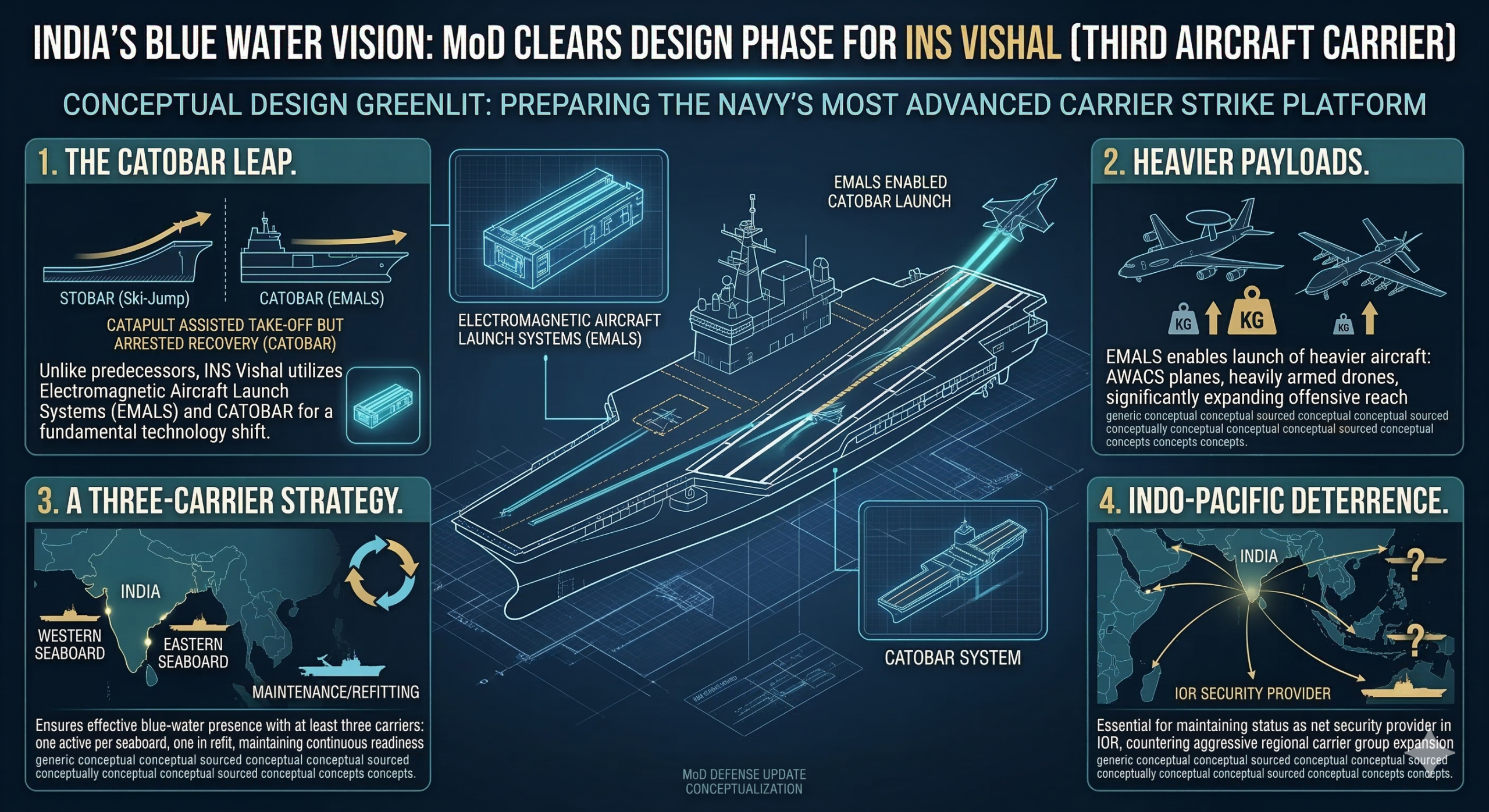
- Overview: Taking a decisive step toward absolute maritime dominance, the Ministry of Defense has officially greenlit the conceptual design phase for India’s third, and most advanced, aircraft carrier—provisionally named INS Vishal.
- Key Points:
- The CATOBAR Leap: Unlike INS Vikramaditya and INS Vikrant, which use a ski-jump (STOBAR) system, INS Vishal is slated to feature a Catapult Assisted Take-Off But Arrested Recovery (CATOBAR) system, likely utilizing Electromagnetic Aircraft Launch Systems (EMALS).
- Heavier Payloads: The EMALS technology will allow the carrier to launch much heavier aircraft, including airborne early warning (AWACS) planes and heavily armed unmanned combat drones, fundamentally shifting the Navy’s offensive reach.
- A Three-Carrier Strategy: A true blue-water navy requires three carriers to remain effective: one deployed on the western seaboard, one on the eastern seaboard, and one undergoing routine maintenance and refitting.
- Indo-Pacific Deterrence: As extra-regional navies aggressively expand their carrier strike groups, INS Vishal is essential to maintaining India’s status as the net security provider in the Indian Ocean Region.
- Q3. What is the primary operational limitation of a STOBAR (Short Take-Off But Arrested Recovery) aircraft carrier system compared to a CATOBAR system?
- It cannot recover aircraft, requiring them to land on coastal runways.
- It forces fighter jets to take off with significantly lighter fuel and weapon payloads due to the lack of a catapult assist.
- It is exclusively powered by nuclear reactors, making it a higher radiation risk.
- It can only launch helicopters and vertical take-off aircraft.
