
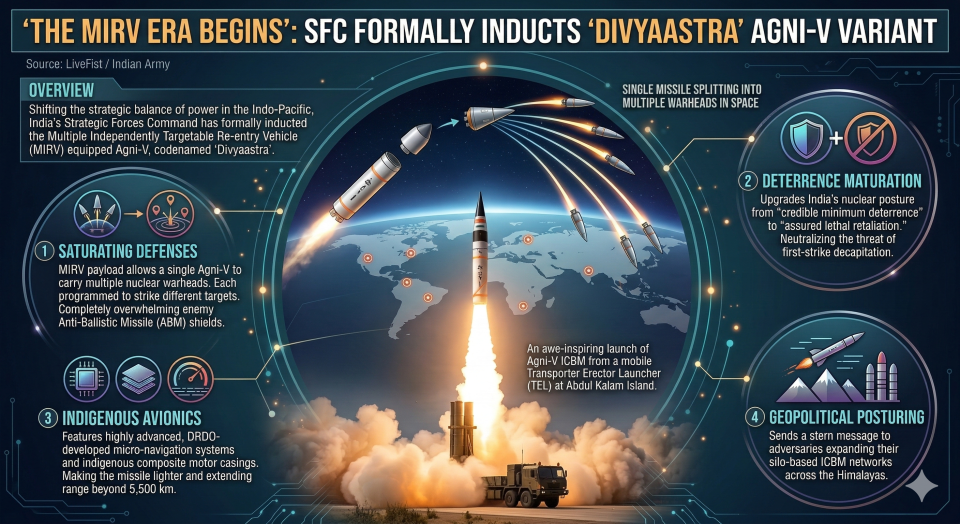
- Overview: Shifting the strategic balance of power in the Indo-Pacific, India’s Strategic Forces Command has formally inducted the Multiple Independently Targetable Re-entry Vehicle (MIRV) equipped Agni-V, codenamed ‘Divyaastra’.
- Key Points:
- Saturating Defenses: The MIRV payload allows a single Agni-V missile to carry multiple nuclear warheads, each programmed to strike different targets, completely overwhelming enemy Anti-Ballistic Missile (ABM) shields.
- Deterrence Maturation: Upgrades India’s nuclear posture from “credible minimum deterrence” to “assured lethal retaliation,” neutralizing the threat of first-strike decapitation.
- Indigenous Avionics: Features highly advanced, DRDO-developed micro-navigation systems and indigenous composite motor casings, making the missile lighter and extending its range beyond 5,500 km.
- Geopolitical Posturing: Sends a stern message to adversaries expanding their silo-based ICBM networks across the Himalayas.
Source Link: DRDO Agni-V Divyaastra Updates
- Q1. What is the primary operational advantage of a Multiple Independently Targetable Re-entry Vehicle (MIRV) payload on a ballistic missile?
- A) It allows the missile to be recalled mid-flight.
- B) It enables a single missile to deliver multiple warheads to distinct, separate targets, bypassing missile defense shields.
- C) It uses conventional explosives to trigger a localized EMP (Electromagnetic Pulse).
- D) It allows the missile to maneuver like a cruise missile within the Earth’s atmosphere.
