
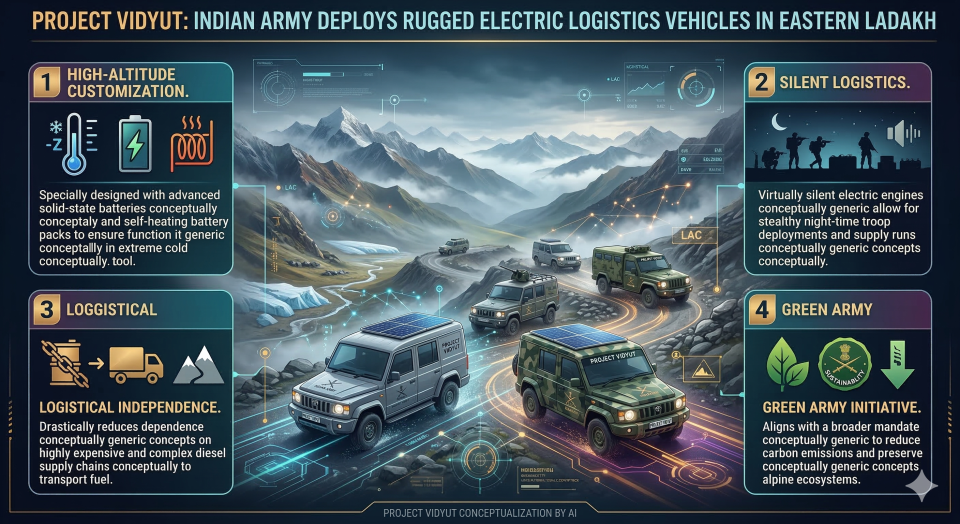
- Overview: Driving sustainability into high-altitude warfare, the Indian Army has officially launched ‘Project Vidyut’, deploying a massive fleet of specially designed, ruggedized Electric Vehicles (EVs) for military logistics in Eastern Ladakh.
- Key Points:
- High-Altitude Customization: These EVs are equipped with advanced solid-state batteries and self-heating battery packs to ensure they function flawlessly in sub-zero temperatures where traditional diesel engines often freeze.
- Silent Logistics: Because electric engines are virtually silent, these vehicles are perfect for stealthy, night-time troop deployments and supply runs near the Line of Actual Control (LAC).
- Logistical Independence: The project drastically reduces the Army’s dependence on highly expensive and complex supply chains needed to transport diesel fuel up the treacherous Himalayan mountain passes.
- Green Army Initiative: This aligns perfectly with the Government’s broader mandate to reduce carbon emissions and preserve the highly sensitive alpine ecosystem of Ladakh.
Source Link: Indian Army Modernization Initiatives
- Q3. Which of the following is the primary operational advantage of using solid-state batteries over traditional lithium-ion batteries in high-altitude military equipment?
- A) They are much heavier, providing better traction in the snow.
- B) They perform significantly better in extreme sub-zero temperatures and have a lower risk of catching fire.
- C) They generate a loud acoustic signature to warn friendly troops.
- D) They run on a mixture of electricity and aviation turbine fuel.
