
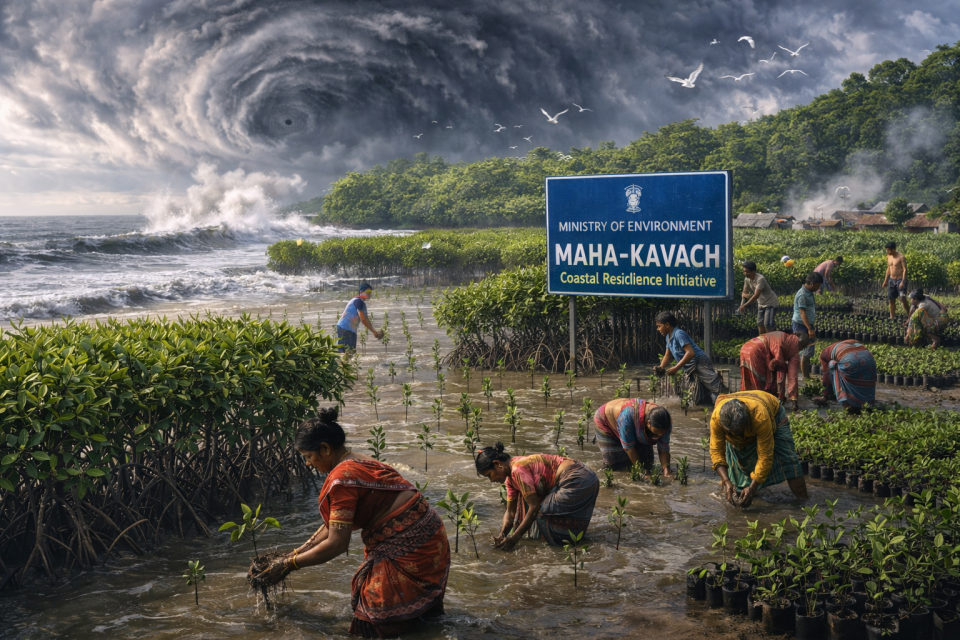
- Overview: In a monumental push to protect its vulnerable eastern seaboard from the devastating effects of climate-induced super cyclones, the Ministry of Environment has officially launched the ‘Maha-Kavach’ (Great Shield) Coastal Resilience Initiative.
- Key Points:
- Nature-Based Defense: Moving away from building expensive, brittle concrete sea walls, this multi-billion rupee project focuses on massive, targeted afforestation of Mangrove forests along the deltas of Odisha, West Bengal, and Andhra Pradesh.
- The Ultimate Shock Absorber: Mangrove root systems naturally dissipate the kinetic energy of massive storm surges and tsunamis, acting as a highly effective, self-repairing biological barrier against coastal erosion.
- Blue Carbon Sinks: Beyond defense, these newly planted coastal forests act as massive “Blue Carbon” sinks, aggressively sequestering carbon dioxide from the atmosphere and aiding India’s Net Zero targets.
- Livelihood Generation: The project directly employs thousands of local coastal communities in the nursery and planting phases, seamlessly blending disaster risk reduction with poverty alleviation.
- Q8. The Sundarbans, designated as a UNESCO World Heritage site, is famous for being the largest contiguous mangrove forest in the world. It is located in the delta formed by the confluence of which major rivers?
- Godavari and Krishna
- Narmada and Tapti
- Ganges, Brahmaputra, and Meghna
- Mahanadi and Subarnarekha
