
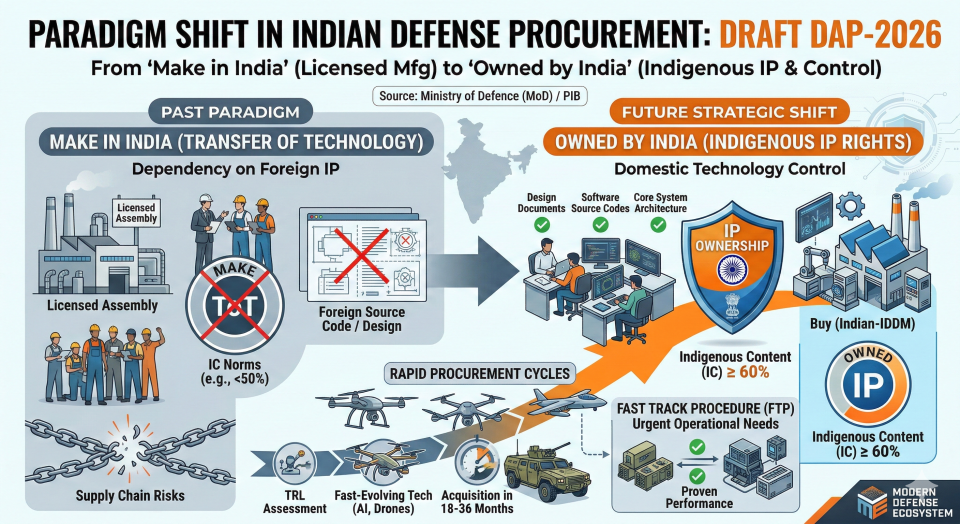
Overview: The Defence Ministry’s draft Defence Acquisition Procedure (DAP-2026) marks a monumental shift from licensed manufacturing to indigenous technological ownership. By mandating Indian control over intellectual property, source codes, and design architecture, the policy aims to bulletproof India’s defense ecosystem against supply chain vulnerabilities and technological obsolescence.
Key Points:
- The DAP-2026 shifts the policy focus from “Make in India” (transfer of technology) to an “Owned by India” framework emphasizing domestic Intellectual Property (IP) rights.
- To qualify under the ‘Buy (Indian-IDDM)’ category, companies must now own the design documents, software source codes, and core system architecture.
- Indigenous Content (IC) norms have been tightened, mandating at least 60% overall IC in the primary manufacturing categories.
- It introduces rapid procurement cycles aligned with Technology Readiness Levels (TRLs) to acquire fast-evolving tech like AI and drone swarms within 18-36 months.
- The Fast Track Procedure (FTP) is reoriented to bypass lengthy trials for urgent operational needs, favoring equipment with proven performance.
Source Link: PIB Official Release
- MCQ: Under the draft Defence Acquisition Procedure (DAP) 2026, which of the following is a mandatory condition for a product to be classified as ‘Indigenously Designed’ (ID)?
(A) The product must be manufactured solely by a Defence Public Sector Undertaking (DPSU).
(B) The Indian company must own the software source code and core architecture.
(C) A minimum of 90% of the raw materials must be sourced domestically.
(D) The design must be co-developed with a foreign original equipment manufacturer.
