
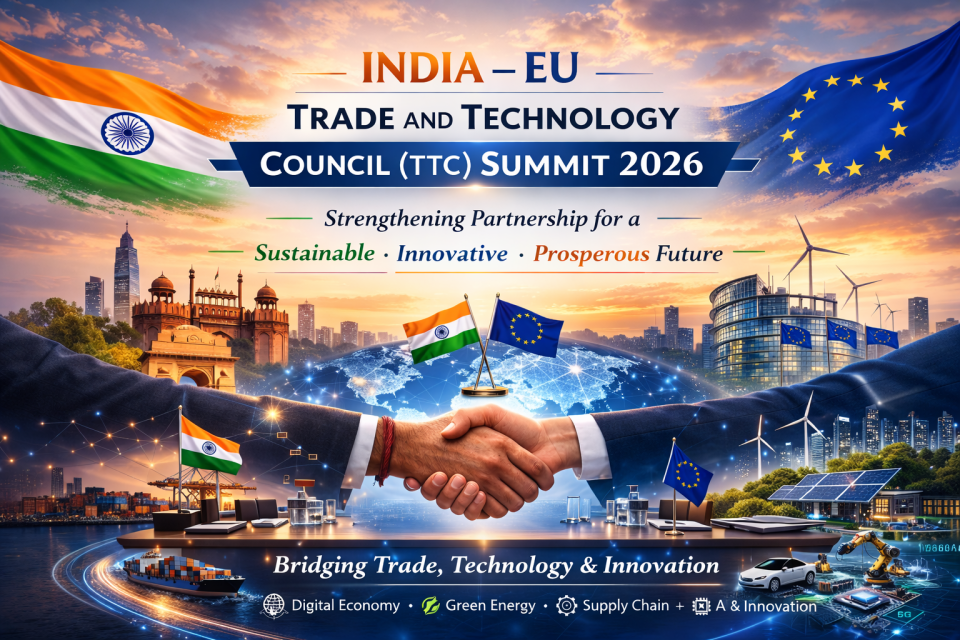
The 3rd India-EU Trade and Technology Council (TTC) Summit concluded in Brussels, marking a pivotal geopolitical alignment. The summit fast-tracked negotiations on the Free Trade Agreement (FTA) and established a joint, legally binding framework to secure critical semiconductor supply chains, actively bypassing Chinese technological dominance.
Key Highlights & Strategic Significance
- Strategic Geoeconomics: The TTC is a premier diplomatic forum that intertwines trade, technology, and security, establishing India as the only country other than the United States to have a TTC framework with the European Union.
- Semiconductor Synergy: Both blocks signed a Memorandum of Understanding (MoU) to integrate India’s semiconductor manufacturing design ecosystem with Europe’s advanced lithography technology (e.g., ASML), ensuring a resilient “China-Plus-One” supply chain.
- AI Governance Alignment: India and the EU agreed to align their regulatory guardrails on Generative Artificial Intelligence, focusing on mitigating algorithmic bias and ensuring that AI deployment respects democratic values and fundamental privacy rights.
- CBAM Dispute Resolution: The summit provided a critical platform for India to negotiate exemptions and transition periods regarding the EU’s controversial Carbon Border Adjustment Mechanism (CBAM), which threatens Indian steel and aluminum exports.
- Digital Public Infrastructure (DPI): The EU officially recognized the robustness of the ‘India Stack’ (UPI, Aadhaar), pledging to collaborate with India to export these open-source DPI frameworks to developing nations in Africa.
Source Link: https://www.mea.gov.in/press-releases.htm?dtl/37501/India+EU+TTC+Summit
Q. The ‘Carbon Border Adjustment Mechanism (CBAM)’, recently a point of contention in international trade negotiations, is an initiative primarily introduced by which of the following?
A) The World Trade Organization (WTO)
B) The United States of America
C) The European Union (EU)
D) The United Nations Environment Programme (UNEP)
