
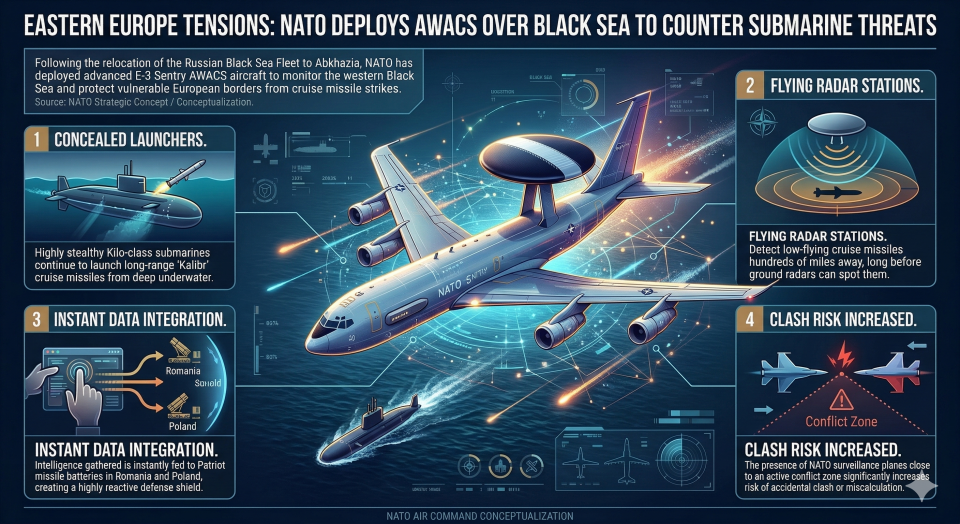
- Overview: Following the relocation of the Russian Black Sea Fleet to Abkhazia, NATO has deployed a fleet of advanced E-3 Sentry AWACS aircraft to monitor the western Black Sea and protect vulnerable European borders from cruise missile strikes.
- Key Points:
- The Submarine Threat: While Russian surface ships have retreated, its highly stealthy Kilo-class submarines continue to launch long-range ‘Kalibr’ cruise missiles from deep underwater.
- Eye in the Sky: NATO’s AWACS (Airborne Warning and Control System) planes act as flying radar stations, capable of detecting low-flying cruise missiles hundreds of miles away, long before ground radars can spot them.
- Early Warning Network: The intelligence gathered by these planes is instantly fed to Patriot missile batteries stationed in Romania and Poland, creating a highly reactive defense shield.
- Escalation Risk: The presence of NATO surveillance planes so close to an active conflict zone significantly increases the risk of an accidental clash or miscalculation.
- Source Link: NATO Air Command Deployments
- Q5. In military aviation, what is the primary function of an ‘AWACS’ aircraft?
- A) To conduct stealth bombing missions deep inside enemy territory.
- B) To act as a mid-air refueling tanker for fighter jets.
- C) To provide long-range radar surveillance, early warning, and command & control of the battlefield.
- D) To jam enemy satellite communications using lasers.
