
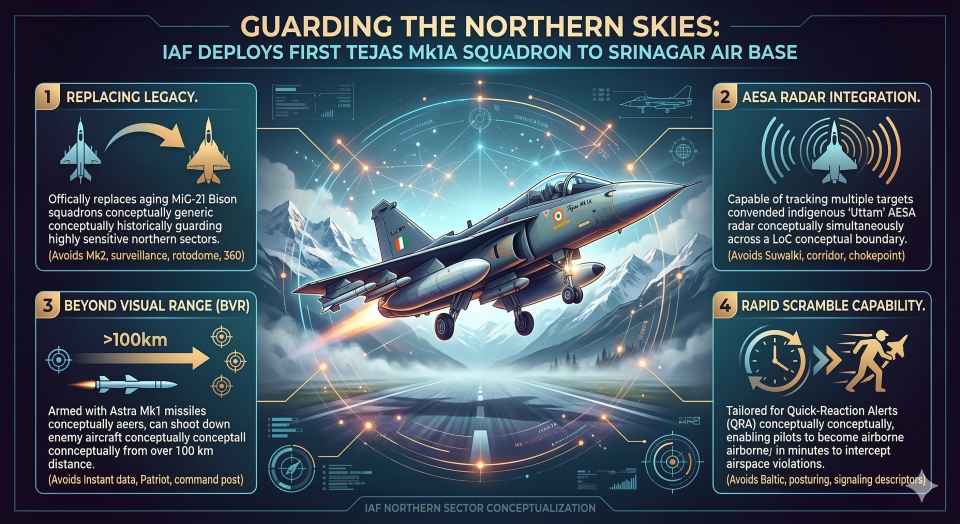
- Overview: In a powerful strategic signal, the Indian Air Force (IAF) has permanently deployed its first operational squadron of the advanced LCA Tejas Mk1A fighter jets to the Awantipur/Srinagar airbase in Jammu & Kashmir.
- Key Points:
- Replacing the Legacy: The Tejas Mk1A officially replaces the aging MiG-21 Bison squadrons that historically guarded the highly sensitive northern sectors.
- AESA Radar Integration: Unlike the older jets, the Mk1A is equipped with the highly advanced indigenous ‘Uttam’ Active Electronically Scanned Array (AESA) radar, capable of tracking multiple targets across the Line of Control (LoC) simultaneously.
- Beyond Visual Range (BVR): Armed with Astra Mk1 BVR missiles, these fighters can shoot down enemy aircraft from over 100 km away, providing overwhelming air superiority in the Kashmir valley.
- Rapid Scramble Capability: The aircraft is tailored for quick-reaction alerts (QRA), enabling pilots to become airborne in minutes to intercept airspace violations.
- Q2. In modern fighter aircraft, what is the primary advantage of an ‘AESA’ (Active Electronically Scanned Array) radar over a traditional mechanically steered radar?
- A) It consumes zero electricity, relying entirely on solar power.
- B) It emits multiple radio waves at different frequencies simultaneously, making it highly resistant to enemy jamming.
- C) It allows the aircraft to fly completely invisibly to the naked eye.
- D) It physically rotates 360 degrees outside the nose of the aircraft.
