
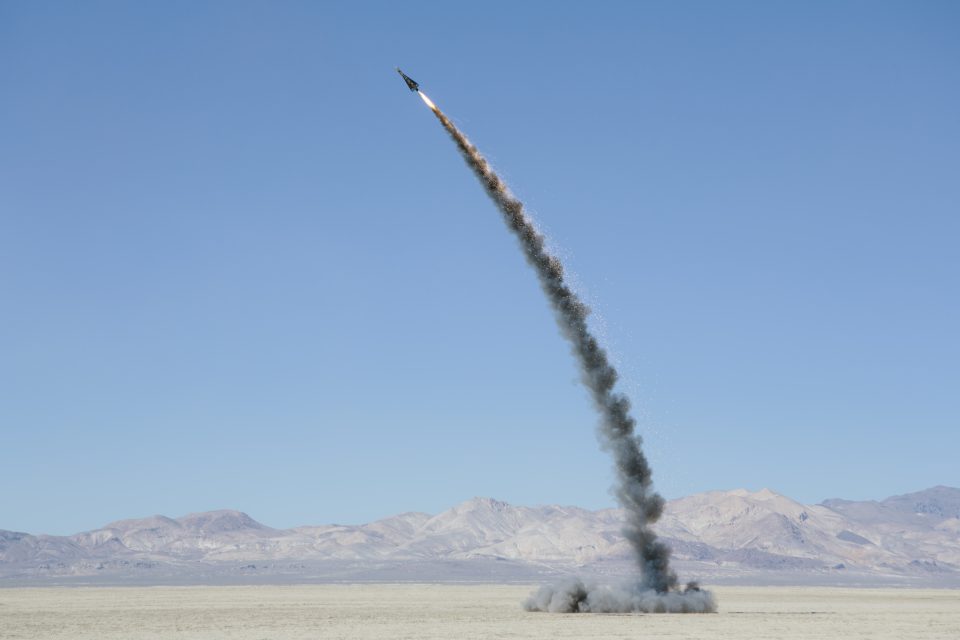
India catapulted into the elite hypersonic club by successfully flight-testing its indigenous Hypersonic Glide Vehicle (HGV) from Dr. APJ Abdul Kalam Island. Launched via a heavily modified Agni-V derivative, the HGV demonstrated extreme atmospheric maneuverability at speeds exceeding Mach 8, cementing India’s strategic deterrence against advanced anti-ballistic missile shields.
Key Highlights & Strategic Significance
- Evasive Trajectory: Unlike traditional intercontinental ballistic missiles (ICBMs) that follow a predictable parabolic arc, the HGV glides and maneuvers through the upper atmosphere, rendering it practically invisible to conventional early-warning radar systems.
- Scramjet Integration: The vehicle utilizes advanced scramjet propulsion technology, maintaining supersonic airflow during combustion, which allows it to sustain hypersonic velocities (above 6,000 km/h) over intercontinental distances.
- Thermal Shielding Mastery: DRDO scientists successfully validated highly advanced, indigenously developed carbon-carbon composite heat shields that protect the internal avionics from the blistering plasma heat generated at Mach 8 friction.
- A2/AD Nullification: This deployment completely nullifies the Anti-Access/Area Denial (A2/AD) bubbles established by adversaries along the Line of Actual Control (LAC), ensuring India’s second-strike capability remains absolute.
- Elite Global Club: With this sustained flight, India joins a highly exclusive geopolitical tier comprising only the United States, Russia, and China, fundamentally altering the strategic balance of power in the Indo-Pacific.
Source Link: https://pib.gov.in/PressReleasePage.aspx?PRID=309881
Q. In the context of missile technology, what primarily distinguishes a Hypersonic Glide Vehicle (HGV) from a traditional Intercontinental Ballistic Missile (ICBM)?
A) An HGV travels exclusively in the vacuum of outer space.
B) An HGV relies entirely on subsonic jet engines for propulsion.
C) An HGV maneuvers unpredictably within the Earth’s atmosphere, whereas an ICBM follows a predictable ballistic trajectory.
D) An HGV cannot carry nuclear warheads due to atmospheric friction.
