
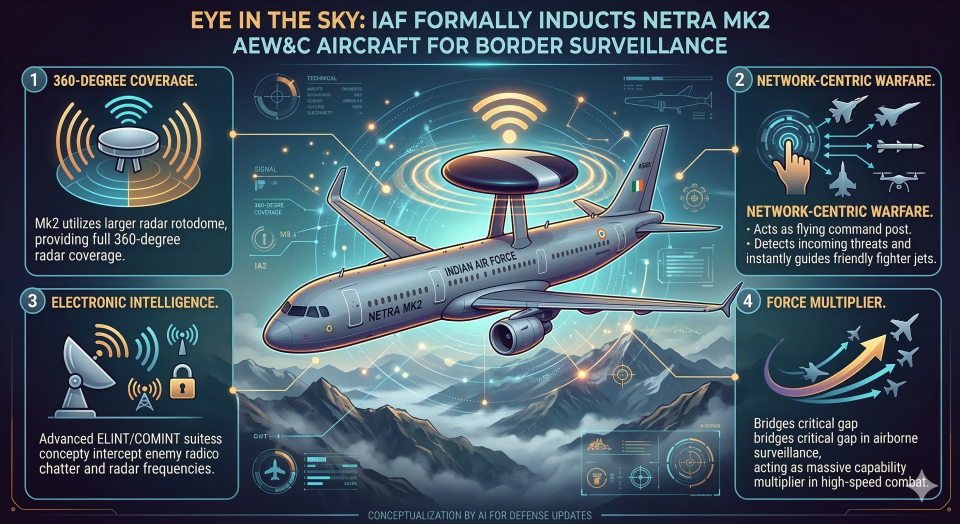
- Overview: The Indian Air Force (IAF) has officially inducted the first squadron of the Netra Mk2 Airborne Early Warning and Control (AEW&C) aircraft, exponentially upgrading India’s aerial surveillance network along the volatile northern and western borders.
- Key Points:
- 360-Degree Coverage: Unlike the older Netra Mk1 which had 240-degree coverage, the Mk2 variant utilizes a larger radar dome (rotodome) mounted on an Airbus A321 aircraft, providing full 360-degree radar coverage.
- Network-Centric Warfare: The aircraft acts as a flying command post. It detects incoming enemy fighters, cruise missiles, and drones from hundreds of kilometers away and instantly guides friendly fighter jets to intercept them.
- Electronic Intelligence: Equipped with advanced electronic and communication intelligence (ELINT/COMINT) suites to intercept enemy radio chatter and radar frequencies deep within hostile airspace.
- Force Multiplier: This induction bridges a critical gap in the IAF’s airborne surveillance capabilities, acting as a massive force multiplier during modern, high-speed aerial combat.
Source Link: Indian Air Force Official Portal
- Q2. In military aviation, what is the primary function of an Airborne Early Warning and Control (AEW&C) system?
- A) To provide mid-air refueling to fighter jets during long-range bombing missions.
- B) To jam enemy communication satellites from high altitudes.
- C) To detect aircraft, ships, and vehicles at long ranges and control the battle space in an aerial engagement.
- D) To conduct stealth bombing runs on heavily fortified enemy bunkers.
