
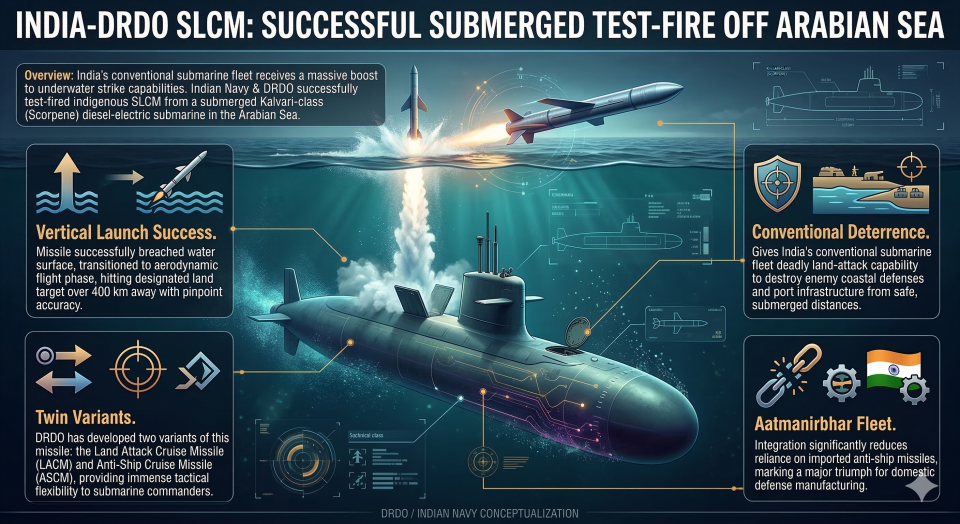
- Overview: In a massive boost to India’s underwater strike capabilities, the Indian Navy and DRDO successfully test-fired the indigenous Submarine-Launched Cruise Missile (SLCM) from a submerged Kalvari-class (Scorpene) diesel-electric submarine in the Arabian Sea.
- Key Points:
- Vertical Launch Success: The missile successfully breached the water surface and transitioned to its aerodynamic flight phase, hitting its designated land target over 400 km away with pinpoint accuracy.
- Conventional Deterrence: This gives India’s conventional submarine fleet a deadly land-attack capability, allowing them to destroy enemy coastal defenses and port infrastructure from safe, submerged distances.
- Twin Variants: The DRDO has developed two variants of this missile: the Land Attack Cruise Missile (LACM) and the Anti-Ship Cruise Missile (ASCM), providing immense tactical flexibility to submarine commanders.
- Aatmanirbhar Fleet: This successful integration significantly reduces the Indian Navy’s reliance on imported anti-ship missiles, marking a major triumph for domestic defense manufacturing.
- Source Link: DRDO Missile Technology Updates
- Q1. The Kalvari-class submarines of the Indian Navy are based on the ‘Scorpene’ design. Which country is the original technology partner for this submarine class?
- A) Russia
- B) United States
- C) France
- D) Germany
