
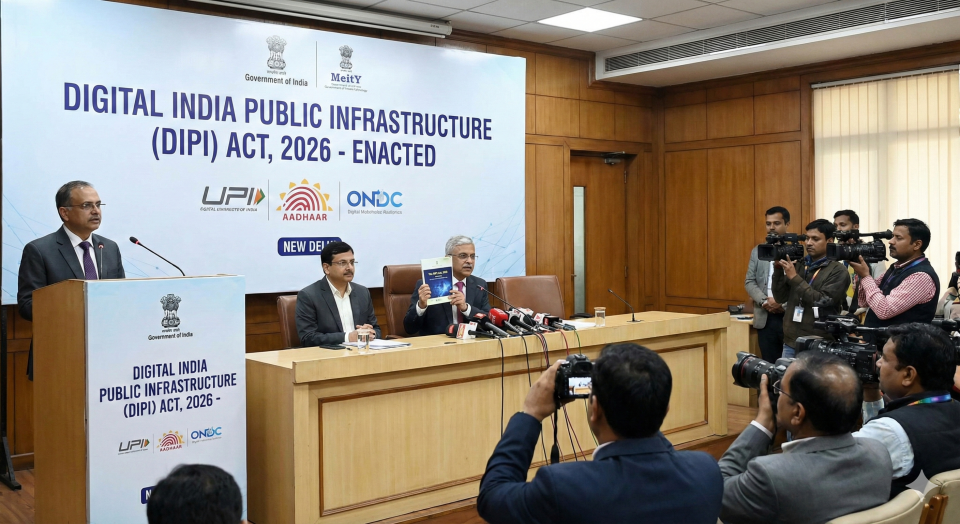
Formalizing the governance of its globally acclaimed technological assets, Parliament successfully enacted the ‘Digital India Public Infrastructure (DIPI) Act, 2026’. This landmark legislation provides robust statutory backing to foundational platforms like UPI, Aadhaar, and ONDC, explicitly outlining their operational, fiduciary, and data-sharing frameworks.
Key Highlights & Strategic Significance
- Statutory Framework: The Act transitions India’s Digital Public Infrastructure (DPI) from purely executive mandates to a legally binding statutory regime, establishing the ‘National DPI Authority’ as the supreme regulatory watchdog.
- Open-Source Mandate: Legally mandates that the core architectural codes of all state-funded digital infrastructures remain strictly open-source and interoperable, ensuring absolute vendor neutrality and preventing proprietary lock-ins by Big Tech.
- Fiduciary Accountability: Imposes strict financial and data fiduciary liabilities on private entities that plug into the DPI ecosystem, prescribing heavy penalties for unauthorized data monetization.
- Global DPI Export: Creates a streamlined, legally sound mechanism for the Ministry of External Affairs to export the ‘India Stack’ to nations in the Global South via state-to-state bilateral technology-sharing agreements.
- Digital Inclusion Guardrails: Explicitly prohibits the complete discontinuation of physical, offline service delivery mechanisms, legally ensuring that the unconnected rural demographic is not disenfranchised by mandatory digitalization.
Source Link: https://prsindia.org/billtrack/digital-india-public-infrastructure-act-2026
Q3. The term ‘India Stack’, frequently mentioned in the context of Digital Public Infrastructure (DPI), fundamentally comprises three foundational layers. Which of the following correctly identifies these layers?
A) Hardware, Software, and Connectivity
B) Identity, Payments, and Data Empowerment
C) Cryptography, Blockchain, and Distributed Ledger
D) E-Governance, E-Commerce, and E-Learning
