
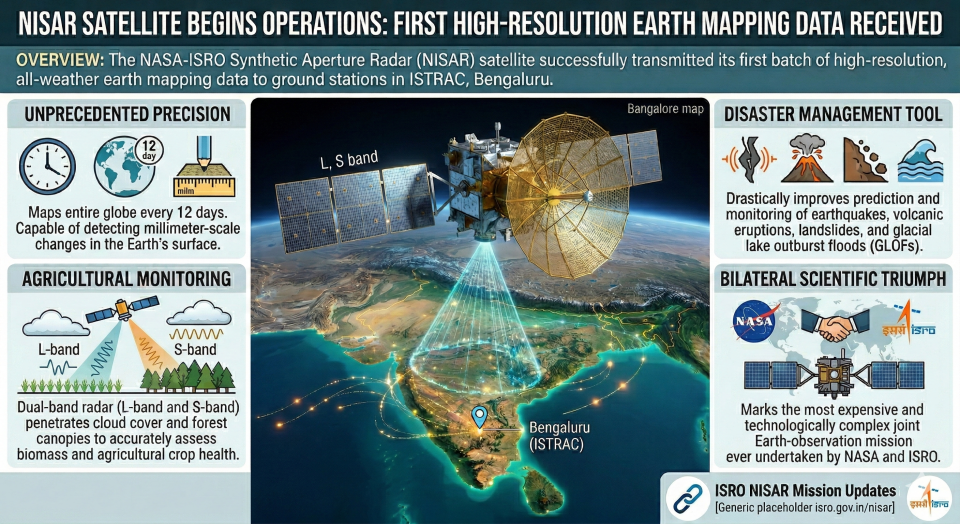
- Overview: The NASA-ISRO Synthetic Aperture Radar (NISAR) satellite, launched earlier this year, has successfully transmitted its first batch of high-resolution, all-weather earth mapping data to ground stations in ISTRAC, Bengaluru.
- Key Points:
- Unprecedented Precision: NISAR maps the entire globe every 12 days, capable of detecting millimeter-scale changes in the Earth’s surface.
- Disaster Management Tool: The data will drastically improve the prediction and monitoring of earthquakes, volcanic eruptions, landslides, and glacial lake outburst floods (GLOFs).
- Agricultural Monitoring: Its dual-band radar (L-band and S-band) penetrates cloud cover and forest canopies to accurately assess biomass and agricultural crop health.
- Bilateral Scientific Triumph: Marks the most expensive and technologically complex joint Earth-observation mission ever undertaken by NASA and ISRO.
Source Link: ISRO NISAR Mission Updates
- Q7. Which of the following statements is INCORRECT regarding the NISAR mission?
- A) It is a joint Earth-observing mission between NASA and ISRO.
- B) It operates exclusively using optical sensors to capture high-definition images.
- C) It carries both L-band and S-band Synthetic Aperture Radar (SAR) instruments.
- D) It is placed in a Sun-synchronous orbit.
