
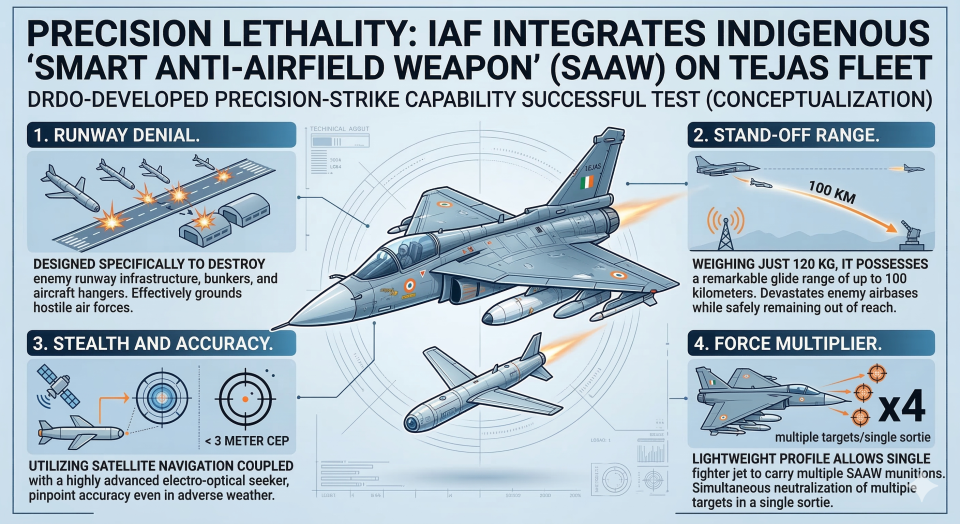
- Overview: In a massive boost to India’s precision-strike capabilities, the Indian Air Force has successfully integrated and live-fired the DRDO-developed Smart Anti-Airfield Weapon (SAAW) from its indigenous LCA Tejas fighter jets.
- Key Points:
- Runway Denial: The SAAW is a highly specialized, precision-guided glide bomb designed specifically to destroy enemy runway infrastructure, bunkers, and aircraft hangers, effectively grounding hostile air forces.
- Stand-Off Range: Weighing just 120 kg, it possesses a remarkable glide range of up to 100 kilometers. This allows Indian pilots to devastate enemy airbases while safely remaining out of reach of short-range air defense systems.
- Stealth and Accuracy: Utilizing satellite navigation coupled with a highly advanced electro-optical seeker, the weapon boasts a circular error probable (CEP) of less than three meters, ensuring pinpoint accuracy even in adverse weather.
- Force Multiplier: Because of its lightweight profile, a single fighter jet can carry multiple SAAW munitions, allowing for the simultaneous neutralization of multiple targets in a single sortie.
- Q1. In modern military terminology, what is the primary operational advantage of a “Stand-Off Weapon” (SOW)?
- It uses nuclear fusion rather than fission to create an explosion.
- It allows an aircraft to attack a target from a distance that exceeds the range of the enemy’s local air defenses.
- It is a stationary weapon system placed on international borders to deter infantry crossings.
- It operates entirely underwater to target enemy submarines.
