
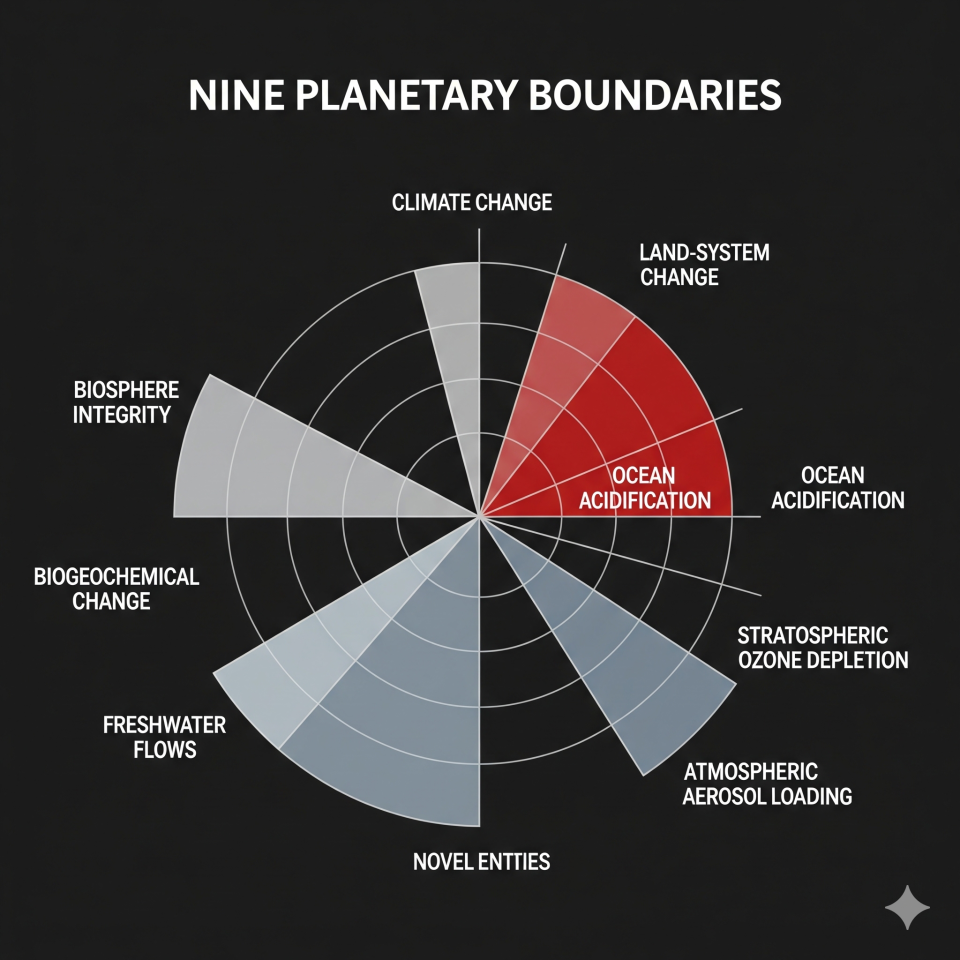
Overview: The newly released “State of India’s Environment 2026” (SOE) report highlights an alarming ecological crisis. Humanity has now breached seven of the nine global planetary boundaries, with ocean acidification being the newest addition. Domestically, the report flags a severe spike in human-tiger conflicts driven by habitat degradation and invasive species.
Key Points:
- Seven of the nine ‘planetary boundaries’ have now been breached globally, with Ocean Acidification becoming the seventh (surface ocean acidity has risen by 30-40%).
- Global forest cover has dropped to 59%, falling dangerously below the required 75% safe minimum threshold for planetary stability.
- Human-tiger conflicts in India are escalating rapidly, with at least 43 human fatalities recorded in the first half of 2025 alone.
- Due to shrinking corridors, approximately 40% of tiger territory in India is currently shared by nearly 60 million people.
- The spread of invasive plant species, particularly Lantana camara, is creating predator-friendly thickets while simultaneously depleting the natural herbivore prey base.
Source Link: CSE India Official Release
Q. With reference to the ‘Planetary Boundaries’ framework often cited in environmental assessments, which of the following is the most recently identified boundary to have crossed the safe operating space?
A) Stratospheric ozone depletion
B) Ocean acidification
C) Atmospheric aerosol loading
D) Freshwater consumption
