
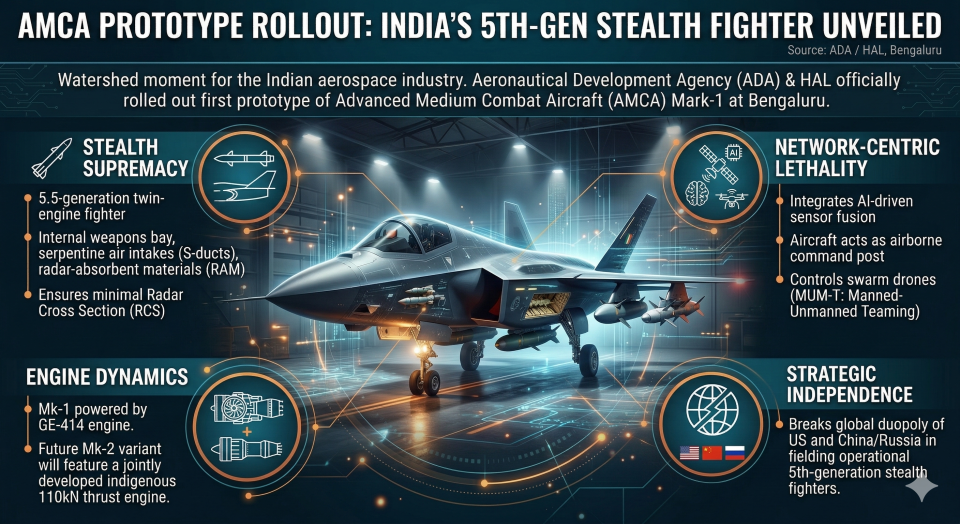
- Overview: In a watershed moment for the Indian aerospace industry, the Aeronautical Development Agency (ADA) and HAL officially rolled out the first prototype of the Advanced Medium Combat Aircraft (AMCA) Mark-1 at Bengaluru.
- Key Points:
- Stealth Supremacy: The 5.5-generation twin-engine fighter features an internal weapons bay, serpentine air intakes (S-ducts), and radar-absorbent materials (RAM) to ensure a minimal Radar Cross Section (RCS).
- Network-Centric Lethality: Integrates AI-driven sensor fusion, allowing the aircraft to act as an airborne command post controlling swarm drones (MUM-T: Manned-Unmanned Teaming).
- Engine Dynamics: The Mk-1 will be powered by the GE-414 engine, while the future Mk-2 variant will feature a jointly developed indigenous 110kN thrust engine.
- Strategic Independence: Breaks the global duopoly of the US and China/Russia in fielding operational 5th-generation stealth fighters.
Source Link: HAL – AMCA Project Highlights
- Q2. In the context of 5th-generation stealth fighter aircraft, what is the purpose of ‘Serpentine Air Intakes’ (S-Ducts)?
- A) To increase the top speed of the aircraft beyond Mach 3.
- B) To shield the highly reflective engine compressor blades from enemy radar waves, thereby reducing the Radar Cross Section (RCS).
- C) To allow the aircraft to hover vertically like a helicopter.
- D) To cool down the exhaust gases to evade heat-seeking missiles.
