
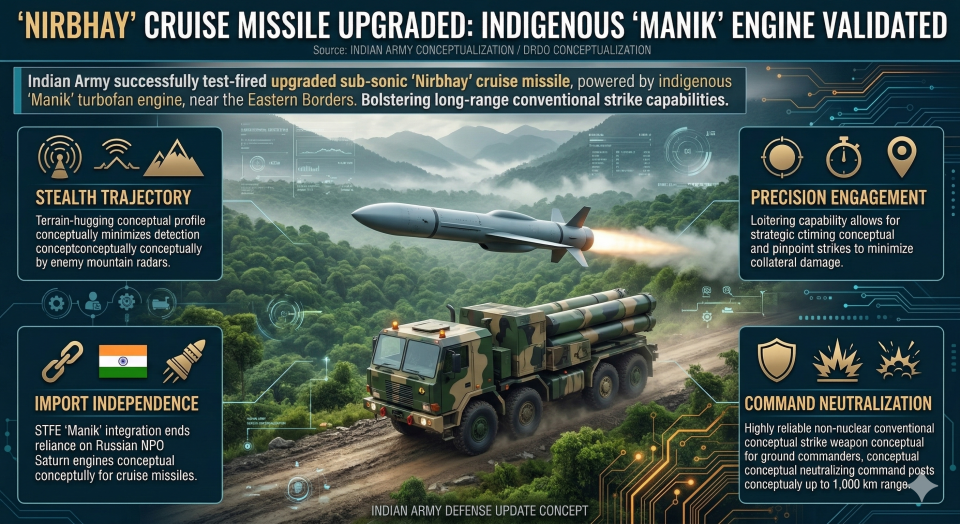
- Overview: Bolstering its long-range artillery strike capabilities, the Indian Army successfully test-fired the upgraded ‘Nirbhay’ sub-sonic cruise missile, now powered by the fully indigenous ‘Manik’ turbofan engine, near the eastern borders.
- Key Points:
- Terrain Hugging: The Nirbhay is capable of flying at extremely low altitudes (tree-top level), making it incredibly difficult for enemy mountain radars to detect.
- Loitering Capability: The missile can circle a target area, wait for the perfect moment, and strike with pinpoint accuracy, minimizing collateral damage.
- Import Substitution: The successful integration of the Small Turbo Fan Engine (STFE) ‘Manik’ ends India’s reliance on Russian NPO Saturn engines for cruise missiles.
- Deterrence Shift: Provides ground commanders with a highly reliable, non-nuclear conventional strike weapon to neutralize enemy command posts up to 1,000 km away.
- Source Link: DRDO Missile Testing Facility
- Q3. Which of the following is a primary difference between a ‘Cruise Missile’ and a ‘Ballistic Missile’?
- A) Cruise missiles carry only nuclear warheads, while ballistic missiles carry only conventional explosives.
- B) Cruise missiles fly within the Earth’s atmosphere for their entire flight, whereas ballistic missiles exit and re-enter the atmosphere.
- C) Cruise missiles cannot be launched from submarines, but ballistic missiles can.
- D) Cruise missiles travel at hypersonic speeds, while ballistic missiles are strictly subsonic.
