
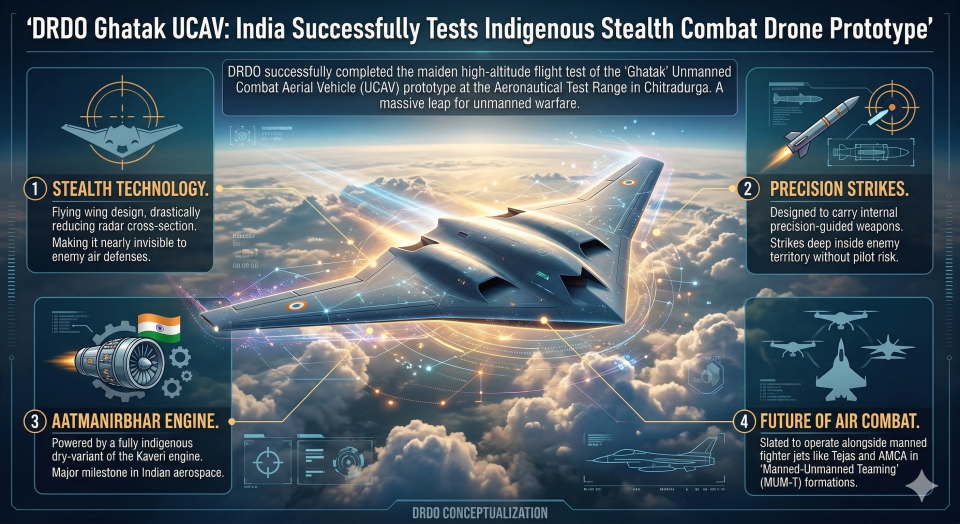
- Overview: In a massive leap for unmanned warfare, the Defense Research and Development Organisation (DRDO) successfully completed the maiden high-altitude flight test of the ‘Ghatak’ Unmanned Combat Aerial Vehicle (UCAV) prototype at the Aeronautical Test Range in Chitradurga.
- Key Points:
- Stealth Technology: The Ghatak drone features a “flying wing” design (similar to the US B-2 bomber), drastically reducing its radar cross-section and making it nearly invisible to enemy air defenses.
- Precision Strikes: Unlike surveillance drones, the Ghatak is designed to carry internal precision-guided weapons to strike deep inside enemy territory without risking a pilot’s life.
- Aatmanirbhar Engine: Powered by a fully indigenous dry-variant of the Kaveri engine, marking a major milestone in Indian aerospace engineering.
- Future of Air Combat: It is slated to operate alongside manned fighter jets like the Tejas and AMCA in ‘Manned-Unmanned Teaming’ (MUM-T) formations.
Source Link: DRDO Aeronautical Systems Updates
- Q1. What is the primary aerodynamic advantage of a ‘Flying Wing’ design in stealth aircraft and drones?
- A) It allows the aircraft to carry more fuel for intercontinental flights.
- B) It completely eliminates the need for an internal engine.
- C) It removes the tail and fuselage, significantly reducing the aircraft’s Radar Cross Section (RCS) and drag.
- D) It allows the aircraft to take off vertically from short runways.
