
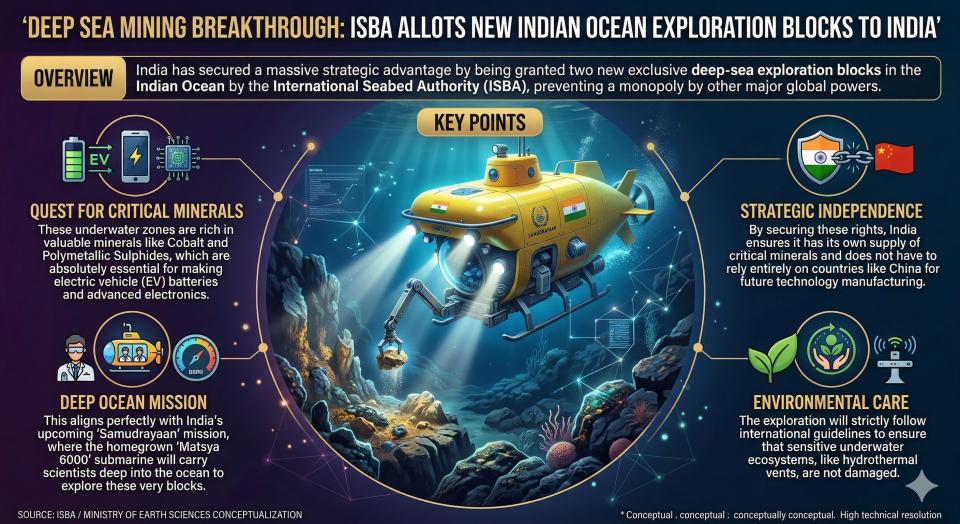
- Overview: India has secured a massive strategic advantage by being granted two new exclusive deep-sea exploration blocks in the Indian Ocean by the International Seabed Authority (ISBA), preventing a monopoly by other major global powers.
- Key Points:
- Quest for Critical Minerals: These underwater zones are rich in valuable minerals like Cobalt and Polymetallic Sulphides, which are absolutely essential for making electric vehicle (EV) batteries and advanced electronics.
- Strategic Independence: By securing these rights, India ensures it has its own supply of critical minerals and does not have to rely entirely on countries like China for future technology manufacturing.
- Deep Ocean Mission: This aligns perfectly with India’s upcoming ‘Samudrayaan’ mission, where the homegrown ‘Matsya 6000’ submarine will carry scientists deep into the ocean to explore these very blocks.
- Environmental Care: The exploration will strictly follow international guidelines to ensure that sensitive underwater ecosystems, like hydrothermal vents, are not damaged.
Source Link: Ministry of Earth Sciences Deep Ocean Mission
- Q7. The International Seabed Authority (ISBA), which regulates deep-sea mining, was established under the framework of which international convention?
- A) Convention on Biological Diversity (CBD)
- B) United Nations Convention on the Law of the Sea (UNCLOS)
- C) The Antarctic Treaty
- D) MARPOL Convention
