
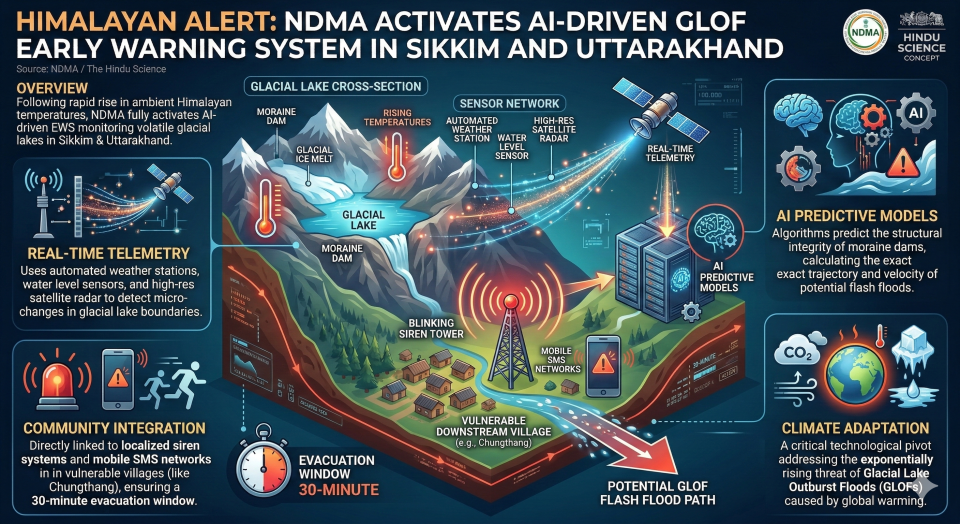
- Overview: Following a rapid rise in ambient Himalayan temperatures, the National Disaster Management Authority (NDMA) has fully activated a state-of-the-art, AI-driven Early Warning System (EWS) to monitor highly volatile glacial lakes in Sikkim and Uttarakhand.
- Key Points:
- Real-time Telemetry: The system relies on a network of automated weather stations, water level sensors, and high-res satellite radar to detect micro-changes in glacial lake boundaries.
- AI Predictive Models: Algorithms predict the structural integrity of moraine dams, calculating the exact trajectory and velocity of potential flash floods.
- Community Integration: Directly linked to localized siren systems and mobile SMS networks in vulnerable downstream villages (like Chungthang), ensuring a 30-minute evacuation window.
- Climate Adaptation: A critical technological pivot to address the exponentially rising threat of Glacial Lake Outburst Floods (GLOFs) caused by global warming.
Source Link: NDMA – Glacial Lake Hazard Management
- Q8. The phenomenon known as ‘GLOF’, which poses a severe threat to Himalayan infrastructure, stands for:
- A) Global Landslide Outburst Failure
- B) Glacial Lake Outburst Flood
- C) Geological Liquefaction of Faults
- D) Ground Level Ozone Fluctuation
