
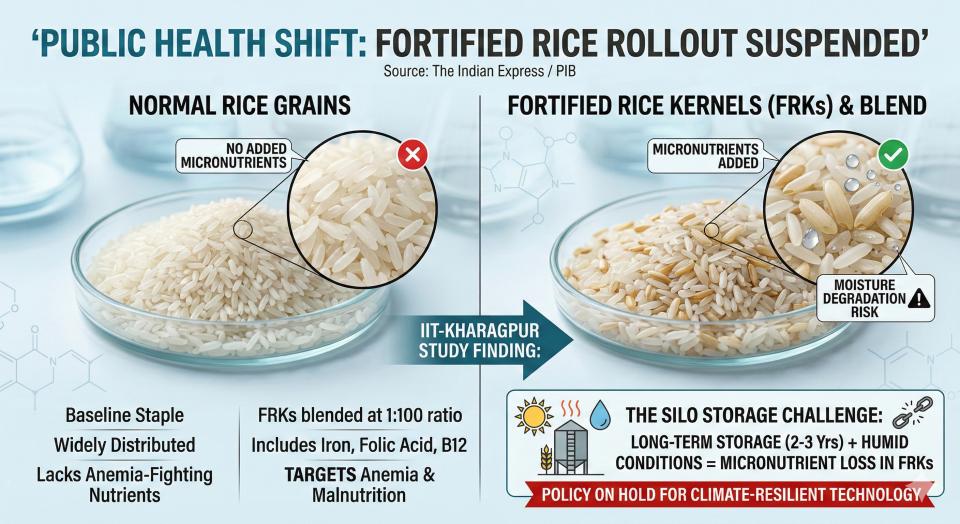
Overview: The Government has temporarily suspended the nationwide mandatory rollout of fortified rice in public distribution schemes. Prompted by an IIT-Kharagpur study revealing that moisture degrades added nutrients during long-term silo storage, the policy is on hold until a more climate-resilient delivery mechanism is developed.
Key Points:
- The fortified rice initiative initially aimed to aggressively combat malnutrition and widespread anemia among women and children.
- An IIT-Kharagpur study found that prolonged storage in humid conditions degrades the micronutrients in the fortified rice kernels.
- India’s high buffer stocks dictate that rice is often stored in silos for 2 to 3 years, exacerbating the nutrient loss issue.
- The rollout is currently suspended to prevent the distribution of ineffective staples through the PDS and mid-day meal schemes.
- Scientific research is now pivoting towards developing resilient fortification technologies that can withstand long-term storage in tropical climates.
Source Link: The Indian Express
MCQ: In the context of public health in India, “Fortified Rice Kernels” (FRK) are typically enriched with which of the following essential micronutrients?
(A) Iron, Folic Acid, and Vitamin B12
(B) Vitamin C and Calcium
(C) Iodine and Vitamin D
(D) Protein and Omega-3 fatty acids
