
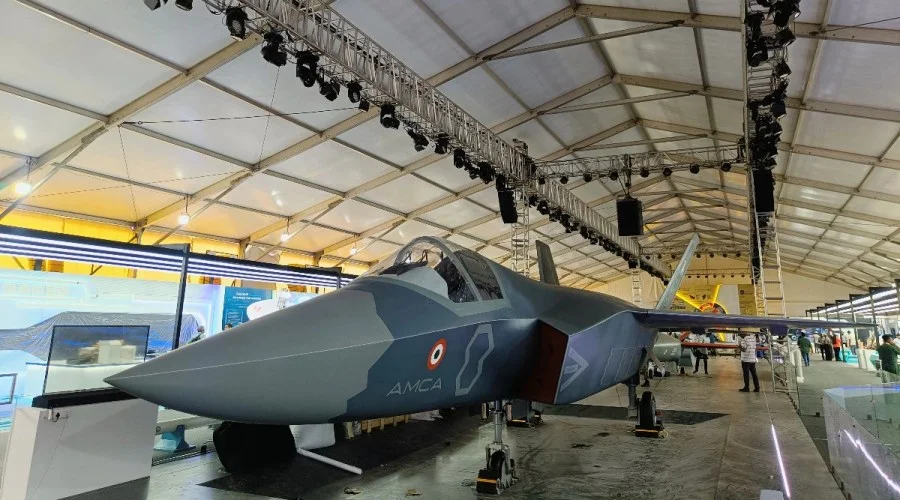
Marking a watershed moment in India’s aerospace history, the Defence Research and Development Organisation (DRDO) and Hindustan Aeronautics Limited (HAL) officially rolled out the first prototype of the Advanced Medium Combat Aircraft (AMCA). This 5.5-generation twin-engine stealth fighter places India in an elite group of nations capable of developing advanced stealth combat aviation autonomously.
Key Points
- Stealth Architecture: Features advanced geometrical stealth, including a serpentine air-intake (S-duct) to hide engine turbine blades from enemy radar, and Radar Absorbent Materials (RAM).
- Internal Weapons Bay: Unlike legacy fighters, the AMCA carries its precision-guided munitions internally to maintain an ultra-low Radar Cross Section (RCS) during deep-penetration strikes.
- Supercruise Capability: Designed to sustain supersonic speeds without the use of fuel-guzzling afterburners, significantly extending its combat radius and loiter time over contested airspace.
- Engine Roadmap: The Mk-1 prototype is powered by imported GE F414 engines, while the future Mk-2 will feature a more powerful, jointly developed indigenous 110kN engine.
Strategic Deterrence: Designed specifically to counter the proliferating stealth fleets of adversaries along the Line of Actual Control (LAC), neutralizing the tactical edge of the Chinese J-20.
Source Link: MoD Updates: AMCA Prototype Rollout
Q1. Which of the following features is the most defining characteristic of a 5th/5.5th generation stealth fighter aircraft like the AMCA?
A) Delta wing configuration with canards
B) An internal weapons bay to minimize radar reflection
C) Ability to take off from short naval aircraft carriers
D) Sole reliance on passive infrared targeting systems
