
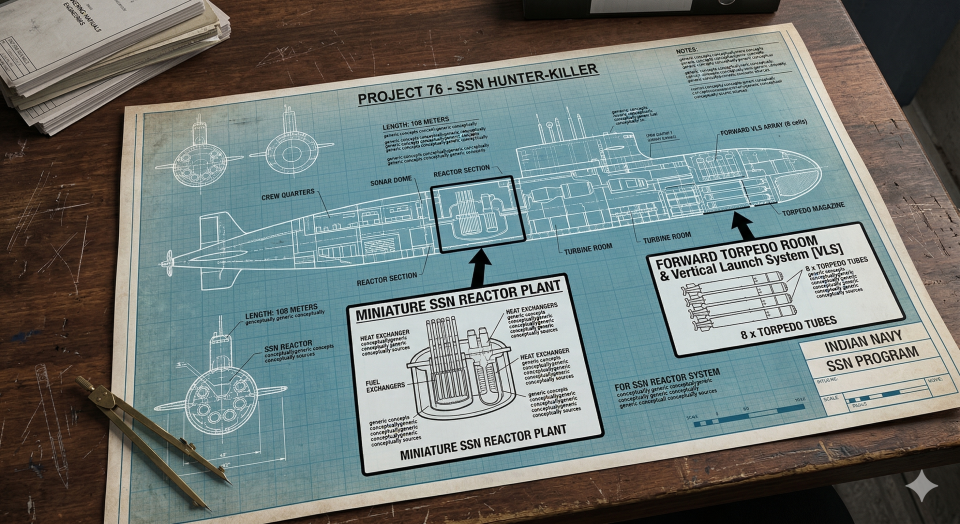
- Overview: The Cabinet Committee on Security (CCS) has given the final green light for ‘Project 76’. In a historic move, India will construct six advanced, nuclear-powered attack submarines (SSNs) entirely on home soil.
- Key Points:
- The Hunter-Killers: Unlike the Arihant-class (SSBNs) which carry nuclear missiles to deter cities, these SSNs are fast, agile “hunter-killers.” Their job is to hunt down and destroy enemy ships and submarines.
- Unlimited Endurance: Because they are powered by miniature nuclear reactors, these submarines never need to surface for air or fuel. They can stay submerged and patrol the deep ocean for months at a time.
- Securing the Indian Ocean: As adversarial navies increase their footprint in the Indian Ocean Region (IOR), these stealthy submarines will serve as India’s premier underwater guardians.
- Make in India Triumph: The submarines will be designed by the Warship Design Bureau and built domestically, injecting billions of rupees into the Indian defense manufacturing sector.
- Q2. What is the fundamental operational difference between an SSN and an SSBN in naval terminology?
- SSNs are diesel-powered, while SSBNs are nuclear-powered.
- SSNs are fast attack submarines designed to hunt other ships, while SSBNs carry long-range nuclear ballistic missiles for strategic deterrence.
- SSNs can only operate in shallow waters, while SSBNs operate in the deep ocean.
- SSNs are unmanned drones, while SSBNs have human crews.
