
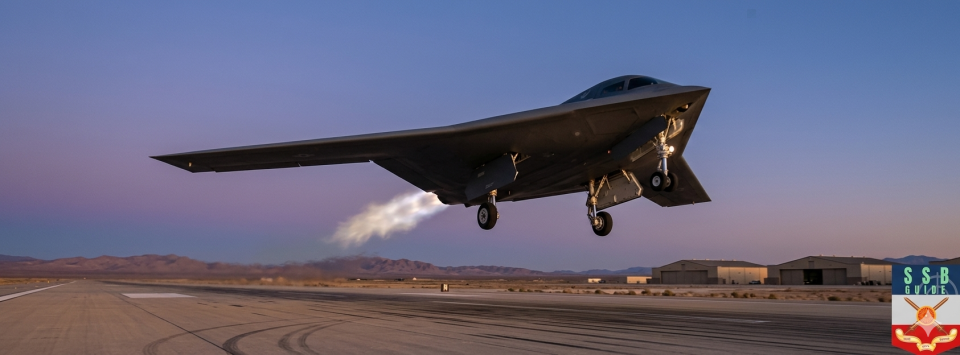
- Overview: The future of unmanned aerial combat is officially here. The Indian Air Force (IAF) has formally inducted its very first squadron of the ‘Ghatak’ Unmanned Combat Aerial Vehicles (UCAV) at a forward airbase in Rajasthan.
- Key Points:
- The Flying Wing: The Ghatak features a tailless, “flying wing” design. This incredibly smooth shape drastically reduces its radar cross-section, making it virtually invisible to enemy air defense radars.
- Autonomous Strike: Unlike standard drones controlled continuously by a joystick, the Ghatak uses artificial intelligence to autonomously fly to a target, drop precision-guided bombs, and return home.
- First-Day-of-War Asset: These stealth drones are designed to fly into heavily defended enemy airspace on the very first day of a war to destroy hostile radar stations and surface-to-air missile batteries.
- Manned-Unmanned Teaming: The IAF will operate these drones alongside manned fighter jets like the Su-30MKI, acting as loyal, lethal wingmen in complex dogfights.
- Q2. In military aviation, what is the primary operational difference between a UAV (Unmanned Aerial Vehicle) and a UCAV (Unmanned Combat Aerial Vehicle)?
- UAVs are controlled by AI, while UCAVs are controlled by human pilots on the ground.
- UAVs are primarily used for reconnaissance and surveillance, while UCAVs are specifically designed to carry and deploy lethal ordnance.
- UAVs operate strictly in the stratosphere, while UCAVs operate near the ground.
- UAVs are entirely solar-powered, while UCAVs use jet fuel.
