
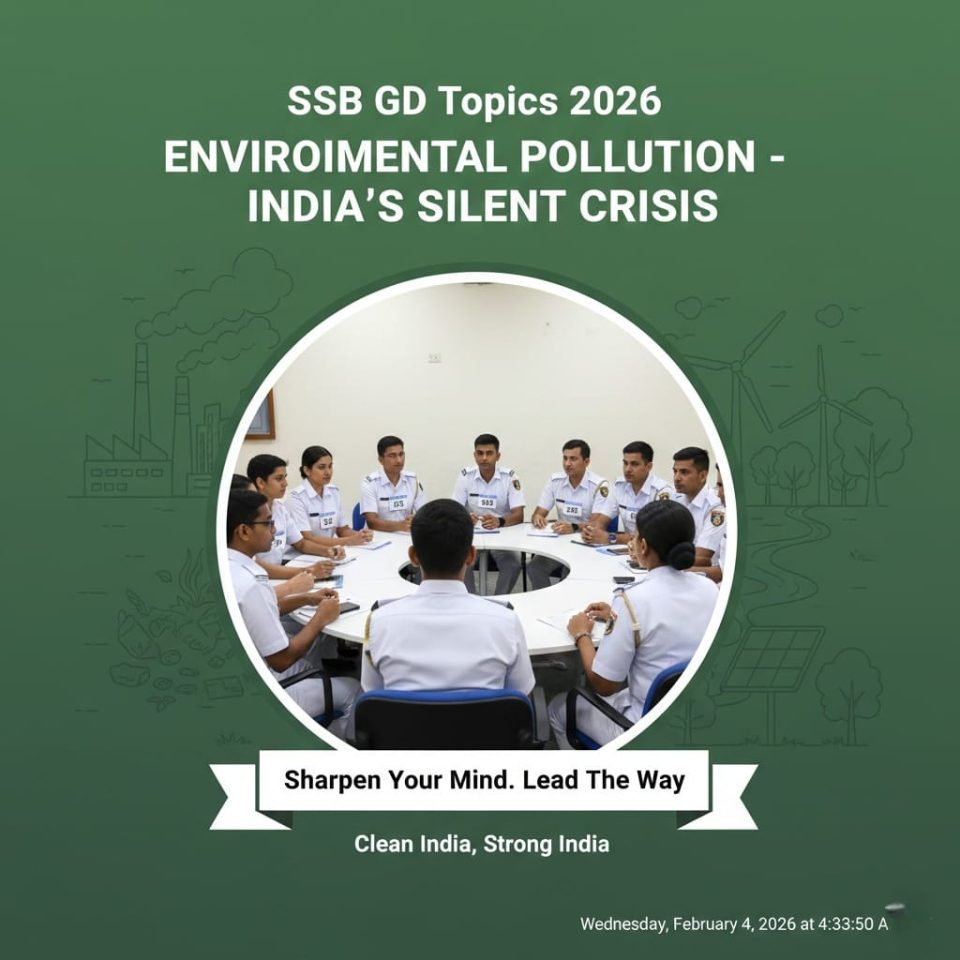
Pollution has become one of India’s most pressing challenges, affecting health, economy, and national security. From air and water pollution to waste management, the issue demands urgent attention. This GD topic tests aspirants on awareness of environmental issues, governance, and sustainable development.
Positive Side (Steps Taken to Control Pollution)
- Government Initiatives: Programs like Swachh Bharat Abhiyan and National Clean Air Programme.
- Renewable Energy Push: Solar and wind projects reduce dependence on fossil fuels.
- Public Awareness: Campaigns encourage citizens to adopt eco‑friendly practices.
- Technological Solutions: Electric vehicles and waste‑to‑energy plants.
- Global Cooperation: India participates in climate agreements and green diplomacy.
Negative Side (Challenges & Concerns)
- Air Quality: Cities like Delhi face severe smog and respiratory issues.
- Water Pollution: Rivers contaminated by industrial waste and sewage.
- Plastic Waste: Single‑use plastics remain a major problem.
- Industrial Pressure: Factories often ignore environmental norms.
- Implementation Gaps: Policies exist but enforcement is weak.
Officer‑Like Perspective
- Pollution is not just an environmental issue—it is a national security and health issue.
- Future officers must understand how pollution affects morale, readiness, and social stability.
- Balanced leadership means promoting sustainable practices with discipline and accountability.
Conclusion
Pollution is India’s silent crisis. Aspirants should conclude GD with a solution‑oriented stance:
“Clean environment is the foundation of a strong nation. India must act now for a sustainable future.”
Practice GD Questions for Aspirants
- Is pollution India’s biggest internal challenge today?
- Should industries face stricter penalties for pollution?
- Can renewable energy solve India’s pollution crisis?
- Is public awareness enough to fight pollution?
- How can India balance development with sustainability?
