
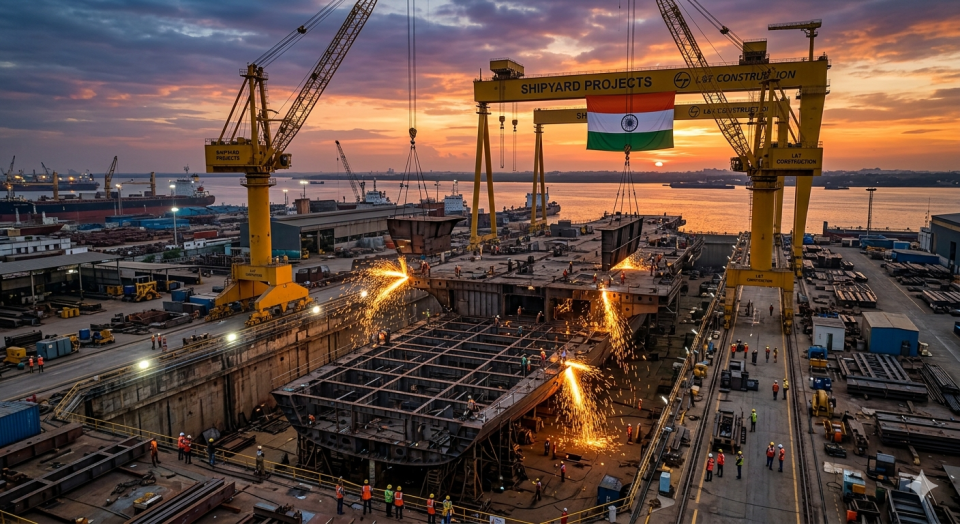
- Overview: The blue-water ambitions of the Indian Navy are expanding rapidly. Today, the Ministry of Defense officially laid the keel for India’s second indigenous aircraft carrier, INS Vishal, at the Cochin Shipyard.
- Key Points:
- A Massive Upgrade: Unlike the INS Vikrant, which displaces 45,000 tons, the INS Vishal will be a 65,000-ton supercarrier. It will carry a significantly larger and more lethal air wing.
- The CATOBAR Leap: INS Vishal will abandon the curved “ski-jump” ramp. Instead, it will use an Electromagnetic Aircraft Launch System (EMALS) to catapult fighter jets off a flat deck.
- Heavier Payloads: A catapult system allows fighter jets to take off carrying much heavier bombs and full fuel tanks. It also allows the carrier to launch heavy, radar-equipped Airborne Early Warning (AWACS) planes.
- The Three-Carrier Strategy: A true maritime power requires three carriers—one for the eastern seaboard, one for the western seaboard, and one undergoing maintenance. INS Vishal fulfills this long-standing strategic necessity.
- Q3. What is the primary operational advantage of a CATOBAR (Catapult Assisted Take-Off But Arrested Recovery) system on an aircraft carrier over a STOBAR (ski-jump) system?
- It requires zero electrical power to operate.
- It allows the carrier to safely operate fully underwater.
- It enables the launch of significantly heavier aircraft, allowing fighter jets to carry maximum fuel and weapons payloads.
- It allows the carrier to launch intercontinental ballistic missiles.
