
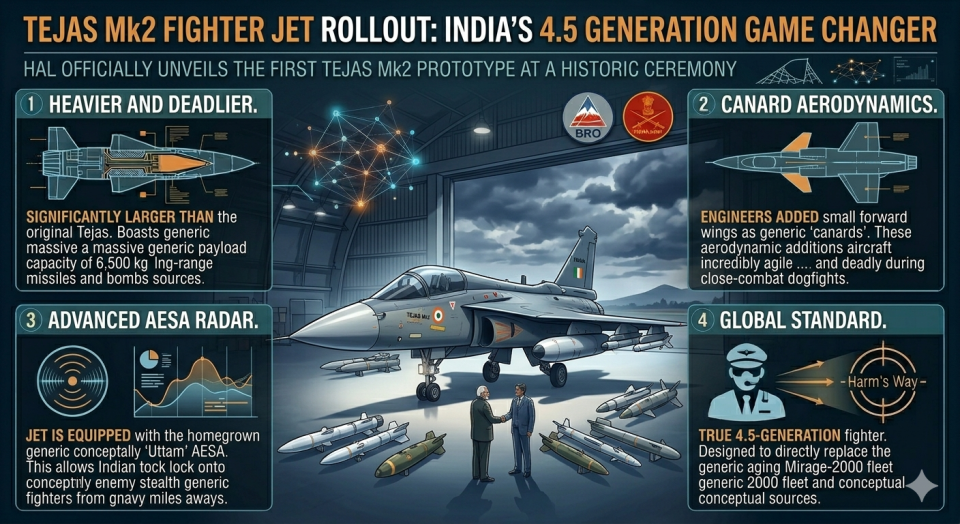
- Overview: Today marks a historic milestone for the Indian Air Force. Hindustan Aeronautics Limited (HAL) officially rolled out the first prototype of the highly anticipated Tejas Mk2 fighter jet.
- Key Points:
- Heavier and Deadlier: The Mk2 is significantly larger than the original Tejas. It boasts a massive payload capacity of 6,500 kg, allowing it to carry a lethal arsenal of long-range missiles and smart bombs.
- Canard Aerodynamics: Engineers have added small forward wings, known as ‘canards’. These aerodynamic additions make the aircraft incredibly agile and deadly during close-combat dogfights.
- Advanced AESA Radar: The jet is equipped with the homegrown ‘Uttam’ AESA radar. This allows Indian pilots to track and lock onto enemy stealth fighters from miles away.
- Global Standard: The Tejas Mk2 is a true 4.5-generation fighter. It is designed to directly replace the aging Mirage-2000 fleet and rival global heavyweights like the Eurofighter Typhoon.
- Q2. What is the primary aerodynamic function of ‘Canards’ on a modern fighter jet like the Tejas Mk2?
- To increase the total fuel capacity of the aircraft.
- To boost the top speed of the jet beyond Mach 3.
- To drastically improve pitch control, lift, and combat maneuverability.
- To absorb radar waves and make the aircraft invisible.
